
Apollo House (Part 4)

Chapter 7: Exposure
The article appeared in the student newspaper on a Tuesday morning.
I was at breakfast when Sebastian slammed the paper down on the table, his face pale with fury.
“We’re fucked,” he said simply.
The headline screamed across the front page: “APOLLO HOUSE: Elite Sex Club or Academic Society?”
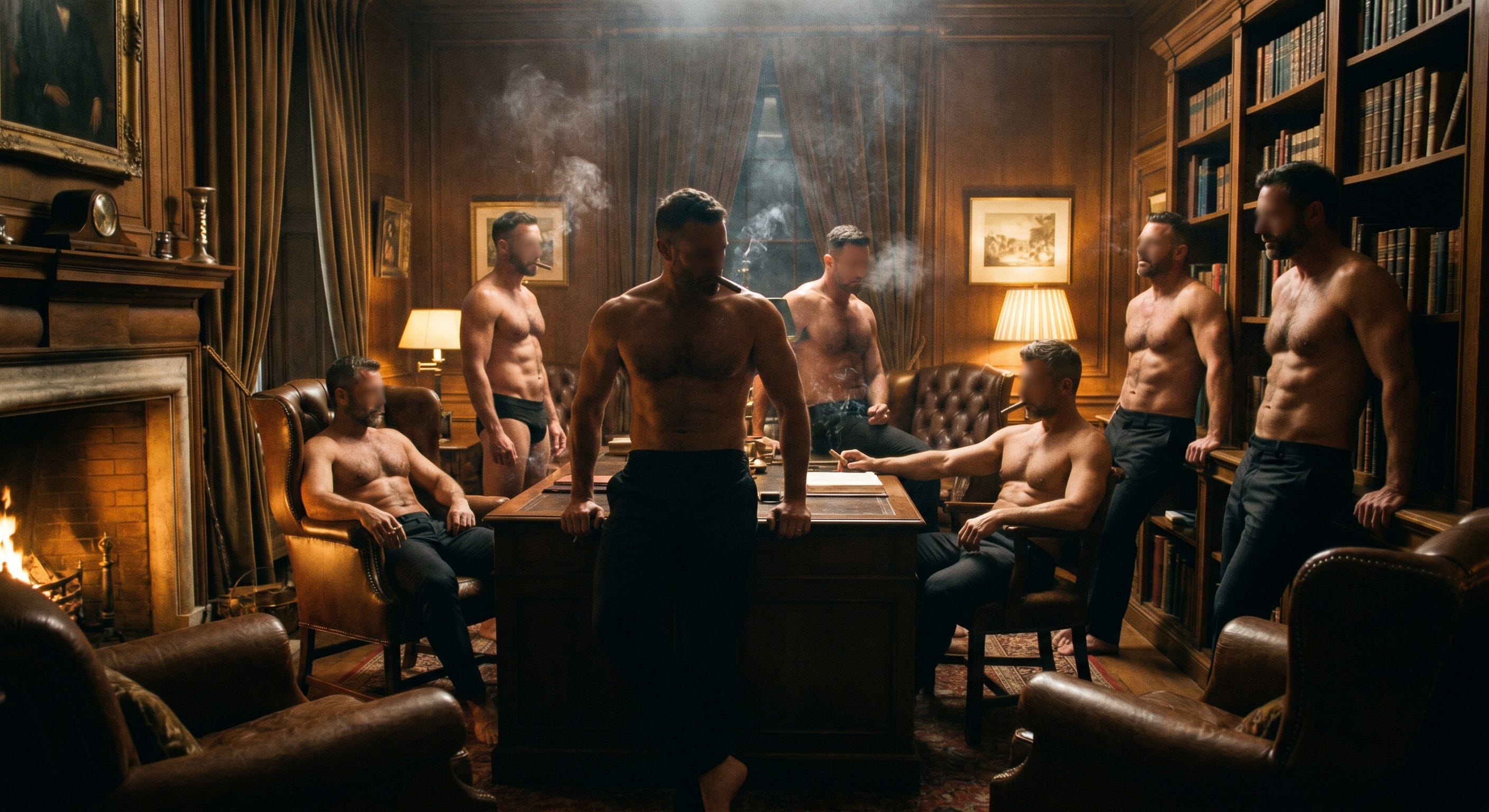
Below it, a photo—grainy but unmistakable. The library windows, curtains not quite closed, bodies visible inside. You couldn’t see explicit details, but the tableau was clear: multiple men, naked, engaged in something decidedly not academic.
“Fuck,” Theo breathed, reading over my shoulder.
The article was devastating in its details. Someone had done research—pulled up Lord Pemberton’s history, the coded references in university archives, testimonies from former residents about the “sexual culture” of the house. They’d interviewed students who’d been invited and fled, uncomfortable with what they’d witnessed.
“What began as a literary society has devolved into something more troubling,” the article claimed. “Behind the facade of classical education and aesthetic appreciation, Apollo House operates as an exclusive sexual network, accessible only to those with the right connections and willingness to participate in increasingly explicit group activities.”
“Who talked?” Marcus asked quietly. “This level of detail—someone inside gave them information.”
“Or someone we invited to symposium,” Julian said. “We’ve been less careful lately. Letting in friends of friends.”
Theo was already pulling out his phone. “I need to call my father’s solicitor. This is libel—”
“Is it though?” I heard myself say. Everyone turned to look at me. “I mean, it’s mostly true. We do have group sex. It is exclusive. The sexual culture is intense.”
“Whose side are you on?” Sebastian demanded.
“Ours. I’m just saying that denying the truth won’t help. They have photos, testimonies, probably more evidence we don’t know about.”
“So what do you suggest?” Theo’s voice was cold. “We apologize? Shut down?”
“We own it. Defend it on our terms rather than letting them define us.”
Before anyone could respond, Carmichael arrived, his face grim.
“I’ve been called to the Dean’s office. There’s going to be an investigation. A committee hearing.” He looked around at all of us. “They’re coming for the house. We need to be ready.”
The backlash was immediate and intense.
By noon, the article had been shared hundreds of times on social media. Comment sections filled with outrage—some defending us, most condemning. Conservative groups called us perverts. Some LGBTQ organizations defended our right to gather but distanced themselves from the sexual elements. Parents called the administration demanding action.
A petition appeared online by evening: “Shut Down Apollo House.” It gained five hundred signatures in the first hour.
Tariq’s name appeared among the early signatories. That hurt more than I expected.
“He actually signed it,” I said, showing Marcus my phone.
“Did you expect different? You chose us over him. This is him choosing his principles over you.”
That night, the house gathered in the library—just residents, no guests. Twenty of us, trying to figure out how to respond.
“We need to shut down symposiums,” David said. “At least until this blows over.”
“Absolutely not,” Theo countered. “That’s exactly what they want. For us to be ashamed, to hide.”
“We should be strategic—” Sebastian started.
“Fuck strategy. We should be honest.” Carmichael stood, commanding attention. “I lived through this before. In the eighties, during the AIDS crisis, when they tried to shut down every queer space, every bathhouse, every gathering place. The ones that survived weren’t the ones that became respectable. They were the ones that refused to apologize for what they were.”
“This is different,” Julian objected. “We’re students. We can be expelled.”
“Then we fight. We make them expel us publicly, make them defend why consenting adults can’t gather and celebrate desire.”
“Easy for you to say,” David shot back. “You’re already retired. Some of us need our degrees.”
The argument continued for hours, getting nowhere. Finally Theo held up his hand.
“We’re having symposium Friday. As planned. Anyone who wants to sit it out can. But I’m not hiding. I’m not pretending shame for something beautiful.”
“It’ll make everything worse,” Marcus warned.
“Good. Let it get worse. Let them see we won’t break.”
The committee hearing was announced for the following week. In the meantime, the university put Apollo House “under review”—which apparently meant we were being watched constantly.
Campus security drove by at odd hours. Administrators we’d never met before found reasons to visit. The pressure was intense and deliberate.
“They’re trying to make us crack,” Carmichael observed. “Give them evidence to use against us.”
Wednesday afternoon, I ran into Tariq outside the library. We hadn’t spoken since the breakup, and seeing him now—after the petition, after everything—made my chest tight.
“James.” He looked uncomfortable.
“You signed the petition.”
“I did. I believe Apollo House is problematic. I always have.”
“So you want us shut down? Want to destroy the only safe space some of these men have?”
“Safe space? James, it’s a sex club for privileged—”
“Some of these men are refugees. Escaped countries where being gay means death. Apollo House is literally the only place they can be themselves.”
That gave him pause. “I didn’t know that.”
“Because you never asked. You made assumptions based on your politics and never bothered to actually understand what we are.”
“Then help me understand. Why does the refuge have to involve group sex? Why can’t it just be community without the explicit sexuality?”
I thought about how to explain it. About the way collective pleasure created bonds that simple friendship couldn’t. About how sharing vulnerability—sexual vulnerability—built trust in ways nothing else could.
“Because the shame they put on us isn’t just about existing. It’s about desiring. About our bodies, our pleasure, our hunger for each other. You can’t fight that shame with half-measures. You have to celebrate the exact things they want hidden.”
He was quiet for a moment. “Can I come? To symposium Friday? Not to participate. Just to witness. To see what I’ve been condemning.”
“Why?”
“Because you’re right that I made assumptions. I want to see it clearly before I double down on having you shut down.”
I should have said no. Should have protected the house from someone who’d signed a petition against us. But looking at his face—genuinely uncertain rather than righteously certain—I found myself nodding.
“Friday. Eight pm. But Tariq—you don’t get to judge. You asked to see, so see. Then decide what you believe.”
Friday night, we gathered with defiant energy. Word had spread that we were proceeding despite everything, and attendance swelled—thirty people, all regulars who wanted to show solidarity.
Theo stood before everyone, magnificent in his anger and conviction.
“They want us ashamed,” he began. “Want us to hide, to pretend we’re something sanitized and safe. But we’re not safe. We’re dangerous. We’re men who refuse to apologize for wanting each other, for celebrating our bodies, for creating beauty through pleasure.”
“For the love of cock,” someone called out, and several people laughed.
“Yes. For the love of cock.” Theo smiled, fierce and beautiful. “So tonight, we’re not holding back. Not moderating ourselves for hypothetical cameras or committee members. Tonight we’re going to be exactly what we are. And if they use it against us, so be it.”
Tariq was there, standing against the back wall, watching with those dark, unreadable eyes.
The readings began—more explicit than usual, deliberately provocative. Sebastian read the most graphic passages from Teleny. Marcus chose Genet at his most pornographic. Carmichael read his own work—unpublished poetry about bathhouse encounters in the eighties, visceral and unapologetic.
I read from The Swimming-Pool Library, the section where the narrator first sees his lover naked in the changing room. Let my voice carry all the hunger and admiration the prose demanded.
And Theo—Theo read Britten’s most explicit letter to Peter Pears, the one where the desire was unmistakable, undeniable. His voice made it a performance, a claiming, a challenge.
When the readings ended, people began to strip. Not tentatively, but deliberately. Throwing clothes aside, revealing bodies without shame. Cocks getting hard immediately, the sexual energy thick and intentional.
Someone brought out the poppers earlier than usual. They circulated fast, everyone breathing deep, the chemical rush lowering inhibitions that were already low.
“Come here,” Theo said to me. Not a request.
I went to him in the center of the room. He was already naked, his cock hard, his eyes dark with intent.
“Kneel,” he commanded.
I dropped to my knees in front of him, acutely aware that thirty people were watching. That Tariq was watching from the back of the room.
“Show them,” Theo said. “Show them what you want. What we all want. No shame. No hiding.”
I took him in my mouth—deep and hungry, giving him everything. His hand went to my hair, controlling the rhythm, and I let him use my mouth while the room watched.
Around us, others were doing the same. Marcus had someone on their knees before him. Sebastian and Julian were locked together, hands and mouths frantic. Carmichael was orchestrating a scene with three younger men, all of them servicing him in sequence.
But the center of attention was us—Theo and me, the explicit display of dominance and submission, desire and worship.
“Touch yourself,” Theo commanded. “Let them see how much you love this.”
I wrapped my hand around my own cock while I continued to suck him, and the dual sensation made me moan around him.
“That’s it. Show them how beautiful submission can be. How liberating.”
I lost myself in it—the taste of him, the control he had over me, the exhibition of being watched while so thoroughly used. When he finally came down my throat, I swallowed everything, then looked up at him with what must have been complete devotion.
“Beautiful,” he said, pulling me to my feet and kissing me deeply.
Then he turned me to face the room. “Who else wants him?”
It should have been degrading. Instead it felt powerful—being desired by multiple people, being offered like a gift.
Marcus came forward first. “Can I fuck you? Here, where everyone can see?”
“Yes,” I breathed.
They bent me over the arm of the sofa—Theo holding my upper body, kissing me while Marcus prepared me quickly and entered from behind. The stretch and fullness made me cry out, and Marcus set a punishing rhythm immediately.
“Everyone can see you taking cock,” Theo murmured against my mouth. “See how much you love it. How perfect you look like this.”
I turned my head and caught Tariq’s expression—shock and arousal warring on his face. His hand had drifted to the front of his jeans, pressing against his obvious erection even as his face showed conflict.
Marcus fucked me hard and thorough, one hand on my hip, the other reaching around to stroke my cock. When he came, he pressed deep and stayed there, grinding into me while I shook beneath him.
“My turn,” Carmichael said, and I looked up to see him approaching with a condom already on.
Marcus pulled out carefully, and Carmichael took his place immediately—no pause, no recovery time. Just another cock filling me while I gasped and tried to process the intensity.
“You can take it,” Carmichael coached, his older voice steady and assured. “You’re made for this. Made to be used and worshipped and celebrated.”
He fucked me slower than Marcus, more deliberately, and reached around to my nipples—played with them while he moved inside me until I was incoherent with sensation.
Around us, the room had dissolved into complete debauchery. Bodies everywhere, every surface occupied. The sounds of sex—moaning, gasping, skin on skin, the wet slide of penetration and the rhythmic slap of fucking.
I came with Carmichael inside me, untouched, just from the overwhelming stimulation and exposure and wrongness-that-felt-right of it all.
After, I collapsed onto the sofa, thoroughly used and utterly satisfied. Theo gathered me against his chest, possessive and tender.
“You were perfect,” he murmured. “So fucking perfect.”
The symposium continued around us—would continue for hours yet. But I was done, wrung out, floating in that post-orgasmic space where nothing seemed quite real.
Tariq was gone. I noticed his absence vaguely, wondered if we’d pushed him too far, if seeing the reality had confirmed all his worst assumptions.
“Don’t worry about him,” Theo said, reading my expression. “Worry about us. About surviving what comes next.”
What came next was worse than we imagined.
Someone had photographed the symposium. Not Tariq—we’d find out later it was a guest of a guest, someone who’d pretended solidarity while documenting everything.
The photos appeared online Saturday morning. Not explicit—genitals blurred, faces partially obscured—but the context unmistakable. Bodies in sexual congress, group configurations, the orgiastic nature of the gathering clear.
They went viral immediately.
The university released a statement by noon: “The administration is appalled by the images circulating from an unsanctioned student gathering. A full investigation is underway. Apollo House residents should expect disciplinary action.”
My phone exploded with messages—my parents demanding to know what the hell was going on, friends from home asking if the photos were real, Tariq sending a single text: I’m sorry. I didn’t know they’d do this.
“Emergency house meeting,” Theo called out.
We gathered in the library—the scene of our supposed crime. Most residents looked scared now, the defiance of the night before replaced by the reality of consequences.
“They’re going to expel us,” David said flatly. “All of us. Our lives are over.”
“Our lives aren’t over—” Theo started.
“Easy for you to say. Your family has money. The rest of us need our degrees to survive.”
“Then we fight. We make this about rights, about freedom of assembly, about consenting adults—”
“We make this about twenty privileged boys who couldn’t keep their dicks in their pants,” Sebastian interrupted. “That’s what they’ll say. That’s what everyone already thinks.”
Marcus stood. “Maybe that’s true. Maybe we are privileged. But we’re also right. What we do here—it matters. Not despite the sex, but because of it. Because shame is the weapon they use to keep us small and scattered. And we refuse it.”
“Beautiful speech,” Julian said bitterly. “Doesn’t change the fact that we’re fucked.”
Carmichael had been quiet, but now he spoke. “The committee hearing is Monday. They’ll call witnesses, present evidence, make their case. We need to be ready to make ours. Not apologizing, not denying, but defending. Articulately and passionately.”
“Who’s going to testify?” I asked.
“All of us. Anyone willing. We tell our stories—why we need this space, what it provides, why the sexual culture isn’t separate from the intellectual culture but integral to it.”
“I’ll testify,” I heard myself say. “I’ll tell them what Apollo House gave me. All of it.”
One by one, others agreed. Not everyone—three residents decided to move out immediately, distance themselves before the hammer fell. But the core group held.
“We fight,” Theo said. “Together. And if we go down, we go down refusing to be ashamed.”
That night, we held symposium again—smaller, just the committed residents. No guests, no photos, just us.
The sex was different this time. Desperate rather than celebratory. Clinging to each other like we were already saying goodbye.
I ended up in a pile with Theo, Marcus, and Carmichael—all four of us tangled together. They took turns fucking me, gentle and thorough, like they were trying to mark me permanently with their presence.
“I love you,” Theo said, inside me, his forehead pressed to mine. “Whatever happens, I love you.”
“I love you too,” I gasped. “Both of you. All of you.”
We came together in a messy, emotional release, and afterward lay in the wreckage of cushions and blankets and our own satisfaction, holding each other against the uncertain future.
“Monday,” Marcus said quietly. “We find out if any of this survives.”
“It survives,” Theo insisted. “Even if they shut down this house, the idea survives. What we’ve built—the permission we’ve given each other—that can’t be erased.”
I wanted to believe him. Wanted to believe that love and desire and the refusal of shame were enough.
But lying there in the candlelit library, surrounded by the evidence of our supposed transgression, I couldn’t help but wonder if we’d pushed too far, been too honest, loved too openly.
If the price of paradise was exile, was it worth it?
Looking at Theo’s face, at Marcus’s steady presence, at Carmichael’s hard-won wisdom, I knew my answer.
Yes. A thousand times yes.
Whatever came Monday, we’d face it together.
Unashamed.
Brothers to the end.
Chapter 8: Exile
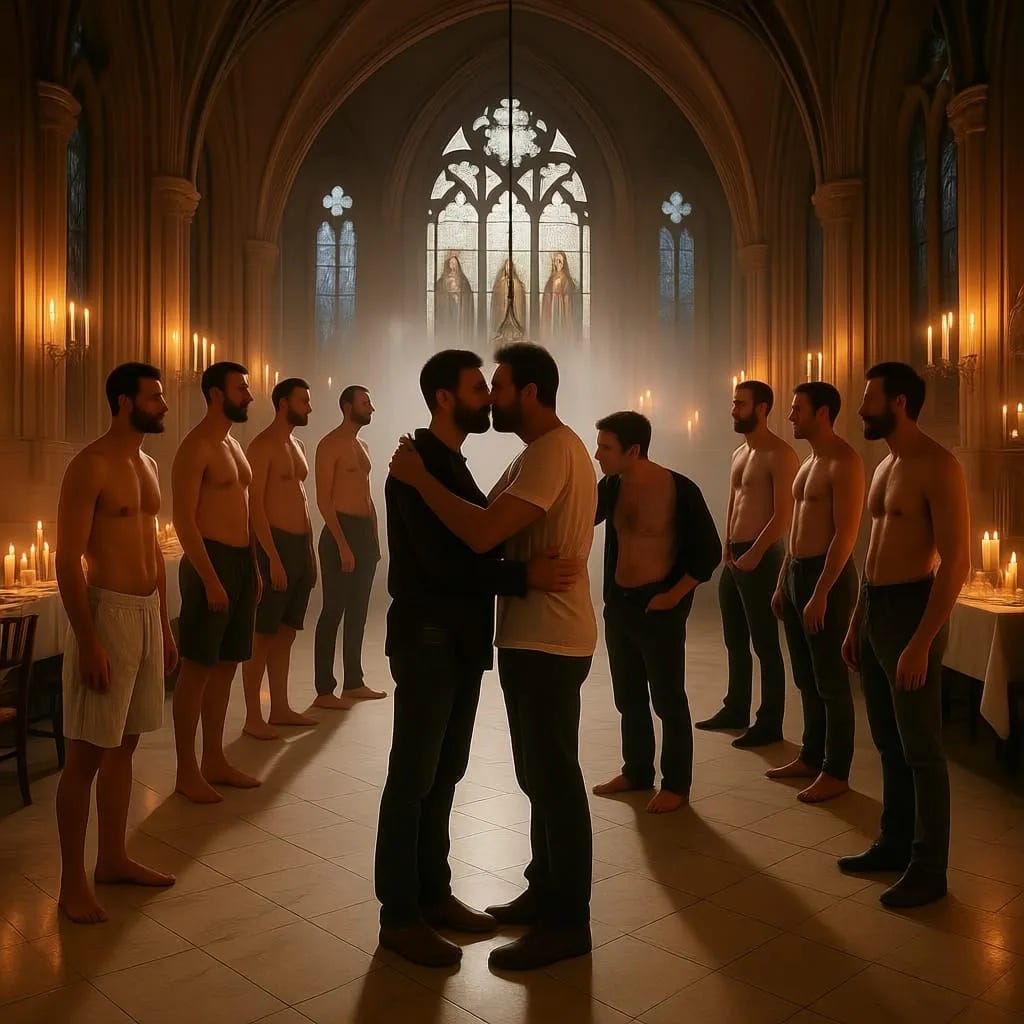
The hearing took place in the Senior Common Room—a deliberate choice, using the most formal space the university had. Oak paneling, portraits of dead scholars glaring down at us, the weight of institutional history pressing from every angle.
The committee consisted of five people: the Dean, Professor Ashdown (who’d been leading the charge against us), Professor Davies (who’d spoken in our favor before), and two external members—a solicitor and someone from the university’s board of trustees.
They called us in one by one.
Marcus went first, spoke for twenty minutes about classical precedent, about the Greek symposium as intellectual and erotic space, about Apollo House as continuation of ancient tradition. He was articulate and unapologetic, and I watched Professor Ashdown’s face harden with every word.
Carmichael testified about the house’s history, about its importance during the AIDS crisis, about the lives it had saved over decades. He named names—successful alumni, including two MPs and a celebrated composer—and made clear that destroying Apollo House meant destroying a vital institution.
“We’re not claiming to be perfect,” he concluded. “But we are necessary. Safe spaces for queer men don’t emerge spontaneously. They’re built, maintained, defended. Apollo House is one of the last of its kind.”
Julian spoke about finding community after years of isolation. David about learning to be unashamed. Sebastian—aristocratic, composed—about the intellectual rigor of the house, the genuine scholarship that happened alongside the sexuality.
Then it was my turn.
I sat across from the committee, feeling their judgment like a physical weight. Professor Ashdown looked at me with barely concealed contempt. The Dean’s face was neutral, unreadable. Davies met my eyes with something like sympathy.
“Mr. Ashford,” the Dean began. “You’ve been a resident of Apollo House for three months. Can you describe the culture there?”
I took a breath, decided on complete honesty.
“It’s the first place I’ve ever felt fully myself. Where I could be intellectual and sexual simultaneously, where my body and my mind weren’t treated as separate things. Where I learned that desire isn’t shameful, that pleasure can be collective and beautiful.”
“By pleasure, you mean sex,” Professor Ashdown interrupted. “Group sex. Public sex. The photographs make that quite clear.”
“Yes. Sex. But also intimacy, vulnerability, trust. You can’t build the kind of community Apollo House has without being willing to be completely seen.”
“And you believe this requires nudity? Explicit sexual activity?”
“I believe shame lives in hiding. That the only way to defeat it is through celebration. Apollo House celebrates male desire without apology. That’s radical because the world constantly tells us our desire is wrong, disgusting, sinful. We refuse that narrative.”
“Even when that ‘celebration’ excludes women entirely?” This from the female trustee. “When it creates a space fundamentally hostile to half the population?”
“We’re not hostile to women. We’re a space for men who love men. That’s different. Should women’s colleges be shut down because they exclude men?”
“Women’s colleges don’t have group sex as part of their residential culture.”
“How do you know?” I shot back. “Maybe they do and they’re just better at hiding it. We’re visible because we refuse to hide. That doesn’t make us worse. It makes us honest.”
The questioning continued for another hour. They pressed on the power dynamics, the potential for coercion, the explicit nature of symposiums, the photographs that had gone viral.
I answered everything honestly. Yes, the sexual culture was intense. Yes, there was social pressure to participate. But no, nobody was forced. No, the power dynamics weren’t abusive. Yes, we understood why it looked problematic from the outside.
“But from the inside,” I finished, “it’s salvation. It’s home. And shutting it down doesn’t make us disappear. It just takes away the one place we had to exist without shame.”
When I was dismissed, I had no idea if I’d helped or hurt our case.
The deliberation took three days. We waited in a collective anxiety spiral—residents barely sleeping, symposiums suspended, everyone too wound up to focus on anything else.
Theo was manic, swinging between fierce optimism and black despair. Marcus stayed steady, a anchor for both of us. Carmichael worked behind the scenes, calling in favors, putting pressure on people who owed him.
The decision came Friday afternoon via formal letter delivered to each resident.
I read mine with Theo and Marcus looking over my shoulder:
Dear Mr. Ashford,
Following a thorough investigation into the residential culture of Apollo House, the committee has concluded that the environment is incompatible with university housing standards. Effective immediately, Apollo House is closed as a residential facility. Current residents have until the end of term to secure alternative accommodation.
You are not being expelled from the university. However, participation in any similar unsanctioned gatherings may result in disciplinary action up to and including expulsion.
The property known as Apollo House will be repurposed for administrative use.
“Fuck,” Marcus breathed.
Theo crumpled the letter, his face white with rage. “They can’t do this. The house has existed for over a century—”
“And now it doesn’t.” I felt numb, disconnected. “We lost.”
“We didn’t lose. We were silenced. That’s different.”
Carmichael appeared in the doorway. “You’ve all seen the letters?”
We nodded.
“Then we need to talk. All of us. Library in ten minutes.”
Twenty residents gathered—the core group who’d stayed through the investigation. We looked shell-shocked, devastated.
“They took our home,” David said quietly. “Just... took it.”
“So we make a new one.” This from Sebastian, who’d been uncharacteristically quiet through the whole crisis. “I’ve been thinking about this. Preparing for this outcome, actually.”
He pulled out his phone, showed us photos. A massive Georgian manor house, golden stone glowing in sunlight, surrounded by parkland and gardens.
“This is Ashworth Hall. My family’s estate in Oxfordshire. Three hundred acres, forty rooms in the main house, multiple outbuildings. It’s been sitting mostly empty for years.”
“Sebastian...” Theo said carefully.
“My father’s in Monaco most of the year, my mother in London. They hate the estate—too expensive to maintain, too far from anywhere interesting. I’ve been trying to convince them to do something useful with it.” He looked around at all of us. “What if we moved Apollo House there? All of us. Made it permanent, not just student housing but an actual community.”
“Your parents would never agree to that,” Julian objected.
“They would if I framed it correctly. A prestigious academic society, very Bloomsbury Group. Scholars and artists in residence. My father’s desperate to keep the property occupied so it doesn’t fall into complete disrepair. He’d sign it over to a trust if it meant solving that problem.”
“He doesn’t know what we actually do,” Marcus said.
“Of course not. And he doesn’t need to. We’d be discreet. But we’d also be free—no university oversight, no committees, no rules except our own.”
The room buzzed with possibility. Moving to a country estate, away from institutional control, building something sustainable and permanent.
“Can we see it?” I asked. “Before we decide?”
Sebastian smiled. “I was hoping you’d say that. I’ve arranged cars. We can drive out tomorrow if everyone’s available.”
We took three cars—fifteen of us making the Saturday pilgrimage to Oxfordshire. The drive took two hours through increasingly rural landscape, until we turned off onto a private road lined with ancient oaks.
Then Ashworth Hall came into view.
“Fuck me,” Omar whispered.
It was magnificent and slightly sinister—all Gothic revival and Georgian proportions, rendered in honey-colored stone that seemed to glow even under the overcast sky. Tall windows, multiple chimneys, a tower at one corner that reminded me painfully of Theo’s tower at Apollo House. Ivy covered sections of the walls, and the grounds spread out in semi-wild parkland that looked like a Romantic painting.
“It’s like Brideshead and Gormenghast had a baby,” Marcus breathed.
“Wait until you see inside,” Sebastian said.
The entrance hall was cavernous—checkerboard marble floors, a sweeping staircase, more portraits of stern ancestors. But also evidence of neglect: dust covers on furniture, a faint smell of damp, the feeling of a house that hadn’t been properly lived in for years.
“East wing is completely closed,” Sebastian explained, leading us through. “Needs major renovation. But the west wing is usable—twelve bedrooms, three bathrooms, the old servants’ quarters could be converted to more rooms. The library—”
He opened double doors, and we all gasped.
The library was twice the size of Apollo House’s, with floor-to-ceiling shelves, a gallery level, massive windows overlooking the gardens, and a fireplace large enough to stand in. It was dusty and neglected, but the bones were perfect.
“There’s more,” Sebastian said, clearly enjoying our reactions.
He showed us the music room with its grand piano and perfect acoustics. The conservatory full of dead plants but gorgeous in its architecture. The formal dining room. The ballroom—an enormous space with parquet floors and crystal chandeliers.
“Imagine symposium here,” Theo said quietly, looking around the ballroom.
“That’s not even the best part,” Sebastian said.
He led us outside, through overgrown gardens, past a small lake, to a stone building half-hidden by trees. When he unlocked the door, we found ourselves in something extraordinary.
A bathhouse. Built in the 1920s, all Classical revival—marble columns, mosaic floors depicting Greek scenes of naked athletes, and at the center, a large sunken pool. The water was drained, the tiles needed cleaning, but the structure was sound and unutterably beautiful.
“My great-grandfather built this,” Sebastian explained. “He was queer. Used to host ‘swimming parties’ for his male friends. Very discreet, very scandalous. Family secret for decades.”
“It’s perfect,” Carmichael said, his voice thick with emotion. “This whole place is perfect.”
We explored for hours. Found the old coach house that could be converted to studios. The cottage that would make perfect guest quarters. The stable block with its hayloft that someone immediately identified as ideal for private encounters.
The estate was massive, isolated, and steeped in exactly the kind of Gothic sensuality that Apollo House had aspired to. Where the university house had been constrained—neighbors, oversight, limited space—this was unlimited possibility.
“How much of the estate can we actually use?” Marcus asked practically.
“All of it. The entire three hundred acres. My father would technically still own it, but we’d have complete control. I’d set up a trust, make it official. He’d be happy to have it occupied and not costing him money anymore.”
“What about staff? Maintenance?”
“There’s a couple who’ve been caretakers for years—they live in the gate cottage. They’d stay on, help with basic maintenance. Everything else we’d handle ourselves.”
We gathered in the ballroom as dusk fell, fifteen men standing in the massive space, and I could see everyone doing the same calculation. Could this work? Could we actually create something permanent here?
“The university took our home,” Theo said quietly. “But maybe they did us a favor. This—” he gestured around the space, “—this is what we were always meant to be. Not students pretending to be respectable. But a true refuge. A chosen family.”
“I want this,” I said. “I want to live here, build something here.”
One by one, others agreed. Not everyone—three residents wanted to stay in the university town, find normal housing. But twelve of us committed on the spot.
“Then it’s decided,” Sebastian said. “I’ll talk to my father. Set up the legal structure. We can move in before term ends.”
That night, we stayed at the estate—sleeping bags scattered through the library and music room, no electricity in most of the house yet, candles providing the only light.
It felt like the first symposium all over again. The newness, the possibility, the slightly dangerous feeling of doing something transgressive.
“We should consecrate the space,” Carmichael suggested. “Mark it as ours.”
“You mean—” Julian started.
“I mean we should have symposium here. Now. Claim this house properly.”
Nobody objected.
We gathered in the ballroom, candles placed around the perimeter, casting enormous shadows on the walls and ceiling. The space was cold—no heating yet—but that somehow added to the atmosphere. Primal. Ancient. Like we were performing some ritual that predated civilization.
Theo stood in the center. “No readings tonight. This isn’t about literature. It’s about claiming space. About marking territory. About refusing to let them destroy what we’ve built.”
“To Apollo House,” Marcus said, raising an imaginary glass.
“To Ashworth Hall,” Sebastian corrected. “To the new Apollo House. To home.”
We stripped in the candlelight, the cold air making our skin prickle, our breath visible. Fifteen naked men in a Gothic ballroom, our bodies casting long shadows, and the atmosphere was charged with something almost sacred.
Theo approached me first, pulled me into a kiss that was possessive and desperate and full of everything we’d been through.
“Mine,” he said against my mouth. “Here. Always. No one can take you from me now.”
“Yours,” I agreed. “Both of yours,” I added, reaching for Marcus.
The three of us sank to the floor, and others joined us—not a pile exactly, but a constellation of bodies, all touching, all connected. Hands moved over skin, mouths explored, and the sexuality was present but secondary to something else. Connection. Claiming. The creation of home through shared vulnerability.
I ended up on my back with Theo above me, his cock sliding against mine while Marcus kissed my neck and Carmichael’s hands were somewhere on my body and someone else’s mouth found my nipple and I lost track of individual sensations in favor of the collective experience.
“This is ours,” Theo said, his voice carrying through the ballroom. “This space, this freedom, this love. They can’t touch it. Can’t regulate it. Can’t take it away.”
When we came—a ripple of orgasms spreading through the connected bodies—it felt like sealing a pact. This house is ours. This life is ours. We refuse to be exiled from ourselves.
After, we lay in a sprawled heap, come cooling on skin, the candles burning down, and looked up at the vaulted ceiling of the ballroom.
“We’re really doing this,” I said. “Leaving the university, moving here, building something permanent.”
“We’re really doing this,” Theo confirmed.
“It’s insane,” Marcus added. “And perfect.”
Carmichael laughed softly. “Apollo House has always been insane. That’s what makes it work.”
The next few weeks were a blur of logistics. Sebastian’s father, thrilled to have the estate problem solved, signed papers creating the “Pemberton Society Trust”—a legal entity that would manage Ashworth Hall as a residential scholarship program for artists and scholars.
He never asked detailed questions about what we’d actually be doing there. Sebastian was right that his father would accept any explanation that let him stop worrying about the property.
We moved out of Apollo House by the end of term, watching sadly as university workers began converting it to administrative offices. The library was being emptied, the books catalogued and dispersed to various departments.
“It’s like watching someone die,” Julian said, as we packed up the last of our belongings.
“It already died,” Theo corrected. “We’re just moving the spirit somewhere it can actually thrive.”
Carmichael managed to save Lord Pemberton’s personal collection—the annotated books, the marginalia, the explicit texts that were too historically valuable to destroy. They’d become the core of Ashworth Hall’s new library.
By early December, twelve of us moved into the estate permanently: Theo, Marcus, me, Sebastian, Julian, David, Carmichael, and five others. We took over the west wing, began the slow work of making the house livable.
Winter at Ashworth Hall was Gothic perfection—fog rolling across the parkland, the house creaking and settling, fires in massive fireplaces the only real source of heat. We wore layers constantly, made love under piles of blankets, turned the cold into part of the aesthetic.
The bathhouse became our obsession. We spent a month cleaning it, repairing tiles, getting the heating system working. When we finally filled the pool and turned on the heat, the result was magical—steam rising in the cold air, the mosaic tiles gleaming, the space transformed into something out of Roman fantasy.
Our first symposium in the bathhouse was transcendent. Bodies in heated water, the steam making everything dreamlike, fucking and floating and celebrating in a space literally designed for this purpose.
“This is what Pemberton wanted,” Carmichael said, floating on his back, watching the rest of us explore each other. “This freedom. This beauty. This refusal to hide.”
By January, word had spread. Men started arriving—friends of residents, people who’d heard about what we were building, queer scholars and artists seeking refuge. We had to establish protocols: how long people could stay, how to vet newcomers, how to maintain the culture while growing.
The symposiums grew larger. Twenty, then thirty, then forty men gathering in the ballroom or bathhouse, celebrating desire and beauty without the constraints of university oversight.
Theo thrived in the new space—more relaxed, less controlling. He still led, but collaboratively now. And his relationship with me deepened into something solid and sustaining.
“I love you,” he said one night, the two of us alone in his room in the tower (we’d claimed it immediately, recreating his old space). “I’m in love with you. And Marcus. And this life we’re building.”
“I love you too,” I said honestly. “All of it. The complications and the beauty and the nastiness and the tenderness.”
“No regrets about leaving the university?”
I thought about it. “None. We’re freer here. More ourselves.”
That night we made love slowly, thoroughly, the sex tender rather than nasty for once. And afterward, lying in his arms looking out at the dark parkland, I thought:
This is home. Not despite the exile, but because of it. They tried to destroy us and instead set us free.
“To Apollo House,” I whispered.
“To Ashworth Hall,” Theo corrected. “To paradise.”
And it was.
Gothic and sensual and completely ours.
Paradise found.
I am speechless with awe! This chapter is everything, destruction but the hope of a new furture! The age old battle of Art and rational mind, is this really the end of the Apollo house series with this chapter? 😢
I like what you're doing because it's audacious. An incredible world of art, love and sex without shame, skill or preference. Desire and respect as the only criteria for entry (artistic talent and good looks seem important, but fortunately you aren't explicit about that). Money as the solution to problems. Some people can't enjoy science fiction because it requires them to suspend belief. That's the only way I can read Apollo House.