
Apollo House (Part 1)

Apologies for not posting for a while. Here’s a new story for you all. Let me know how you like it in the comments.
Chapter 1: Threshold
The college emerged from the mist like something out of a Gothic novel—all grey stone and ivy, perched on a hill above a town too small to appear on most maps. Four hours from London by train, then another forty minutes in a taxi that smelled of damp upholstery and the driver’s roll-up cigarettes. I watched England scroll past the window: sheep, hedgerows, a landscape that seemed determined to prove that nowhere could be this relentlessly pastoral.
“Apollo House, you said?” the driver asked, catching my eye in the rearview mirror.
“That’s right.”
He made a sound that might have been amusement. “Interesting lot, up there.”
I didn’t ask what he meant.
The college itself was small—barely fifteen hundred students—and specialized in the humanities. It was the kind of place people either hadn’t heard of or spoke about in reverent tones. I’d chosen it for the English program, for the library rumored to hold manuscripts you couldn’t see anywhere else, for the promise of being somewhere I could disappear into books entirely.
The taxi dropped me at the main gate. I hauled my bags up the cobbled drive, past the chapel with its spire lost in low cloud, past the library that looked like it predated the Reformation. Students moved between buildings in small clusters, and I registered the first odd thing: almost all of them were men.
Not exclusively—I saw a few women, heads bent together in conversation—but the ratio was striking. Unsettling, even. Had I somehow ended up at a place that was de facto if not de jure male?
I found the porter’s lodge and collected my keys. Apollo House was off the main campus, the porter explained, about ten minutes’ walk up the hill. A specialty residence for humanities and arts students—mostly English, Classics, and Music majors. Only twenty-five rooms. Very competitive to get in.
I hadn’t realized I’d been admitted to something competitive. I’d simply ticked a box on a housing form.
The walk took me through a wooded path, leaves already turning in early September. The house revealed itself gradually: Victorian, three stories of red brick and white trim, with a round tower at one corner that belonged in a fairy tale. Wisteria climbed the south wall. The windows were tall and many-paned, glowing warm in the gathering dusk.
The front door was unlocked.
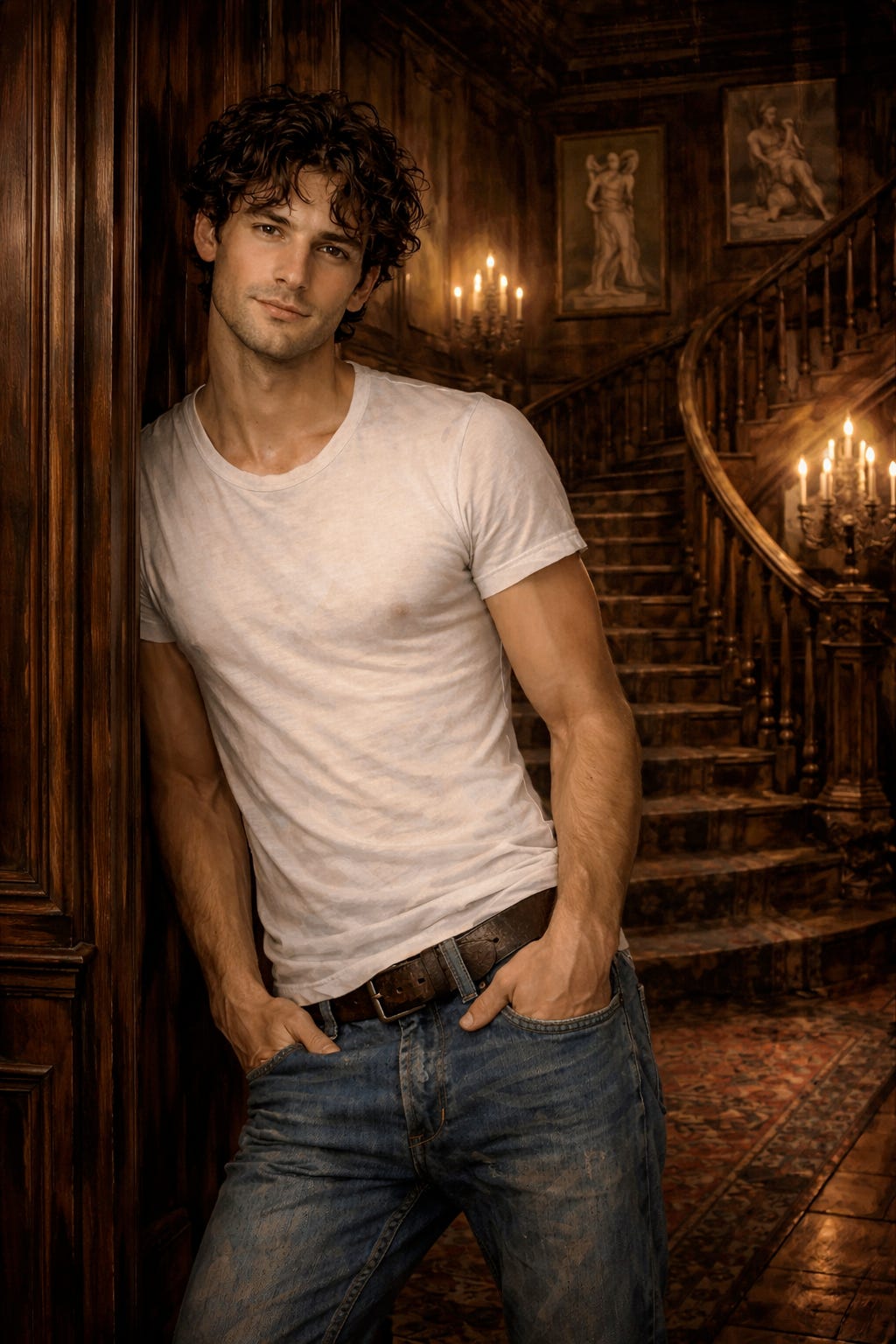
I stepped into an entrance hall that smelled of beeswax and old paper. Dark wood paneling, a curved staircase, framed prints of classical statuary on the walls—mostly male nudes, I noticed. A Discobolus. The Dying Gaul. Antinous in multiple poses.
Voices drifted from somewhere deeper in the house, along with piano music—Chopin, I thought, though I’d never been good at identification.
“You must be the American.”
I turned. A young man stood in a doorway to my left, leaning against the frame with the unselfconscious grace of someone who knew he was beautiful and had long since stopped thinking about it. Tall, slender, dark curls that wanted cutting, and that particularly English complexion that seems to have been invented specifically for candlelight. He wore jeans that hung low on narrow hips and a white t-shirt thin enough to show the shadow of his nipples.
“James,” I said, setting down my bags. “James Ashford.”
“Marcus Lennox.” He didn’t offer to shake hands, just regarded me with open curiosity. “Second year, Classics. Looks like we’re rooming together—they put all the new admits with returning students. Helps with acculturation.” The way he said it suggested this was amusing for reasons I didn’t yet understand.
“Is it always this quiet?”
“God, no. Half the house is still in London. They’ll straggle back over the next few days.” He pushed off from the doorframe. “Come on, I’ll show you up. We’re on the second floor. Tower’s third—that’s Theo’s room. You’ll meet him soon enough.”
I followed him up the staircase, trying not to stare at the way his jeans fit. The first floor landing had more prints—these were photographs, black and white, artistic studies of male dancers mid-leap, their bodies captured in moments of impossible extension.
“The house is a bit much at first,” Marcus said over his shoulder. “But you get used to it. It’s meant to be about classical ideals. The beauty of the male form, all that. Very Brideshead.”
Our room was larger than I’d expected, with two single beds, two desks, and a bay window overlooking the grounds. Someone had already claimed one side—books stacked on the desk, clothes draped over a chair, the bed unmade in a way that suggested recent occupation.
“That’s mine, obviously,” Marcus said. “You’re the organized one, I can tell already.” He flopped onto his bed, hands behind his head. “Fair warning—I sleep naked. The radiators in this place are medieval and it gets hot at night. If that bothers you, say so now.”
It took me a moment to find words. “No. That’s... fine.”
“Good.” He watched me start to unpack with what seemed like genuine interest. “So. Columbia, your application said. Why exile yourself to the middle of fucking nowhere to study English?”
“I wanted something different. Somewhere I could focus.”
“Well, you’ll certainly get different.” He sat up, suddenly more animated. “Do you know anything about the house? Its history?”
“Just what was in the housing materials. Founded in the 1890s, endowed by some Victorian eccentric—”
“Lord Pemberton. Who was, by all accounts, wildly queer and wanted a place where beautiful young men could study Greek together without the interference of women or conventional morality.” Marcus grinned. “Obviously he couldn’t say that, so he dressed it up in rhetoric about classical education and aesthetic philosophy. But the subtext was always obvious.”
I must have looked uncertain because he laughed.
“Don’t worry, it’s not some sort of... cult or anything. But there’s definitely a culture. You’ll see at dinner.”
Dinner was served at eight in a dining room paneled in dark oak, lit by candles in branching candelabras. About fifteen of us gathered around a long table—and yes, I confirmed, all men. The food was simple but good: roast chicken, potatoes, wine in actual glasses.
The conversation was what struck me. These were people who quoted Auden and Horace in the same breath, who argued passionately about the best translation of Sappho, who referenced films I’d never heard of and books I’d pretended to read. The wit was fast and often cruel, but never quite mean—just the intellectual showing-off of very smart young men testing each other’s edges.
And they were all, without exception, gorgeous.
Not conventionally, necessarily. But there was something about each of them—the way Julian, sitting across from me, had paint permanently embedded in the creases of his knuckles; the way Sebastian’s Greek accent made even mundane English words sound like seduction; the way a quiet boy named David had hands that moved with such precision when he gestured that you couldn’t help but watch.
And then there was Theo.
He arrived late, descending from the tower just as we were finishing the main course. The conversation didn’t exactly stop, but it... shifted. Everyone became slightly more aware of their posture, their words.
He was perhaps twenty-two, tall and lean with that aristocratic angularity that British men seem to grow into around their second year at university. Dark hair worn a bit too long, pale skin, and eyes so intensely blue they seemed artificial. He wore black jeans and a white shirt with the sleeves rolled up, and he moved like someone who’d trained in dance or fencing—controlled, economical, graceful.
“Sorry,” he said, sliding into the chair at the head of the table. “Lost track of time.” His voice was remarkable—rich and resonant, the kind of instrument that had clearly been trained. “You must be James.”
“Yes.”
“Theo Ashworth. Music, third year. Welcome to Apollo House.” He poured himself wine, those blue eyes holding mine for a beat too long. “Marcus looking after you?”
“He’s been very helpful.”
“Good.” Theo smiled, and something in my chest tightened. “You’ll find we take care of each other here. It’s necessary, this far from civilization.”
After dinner, several people drifted into the common room. Someone put on a record—Purcell, the mournful strings filling the space. Julian sprawled on the sofa with his sketchbook. Sebastian and another boy played chess in front of the fire. Marcus settled into an armchair with a copy of the Odyssey, still in Greek.
I felt suddenly, acutely aware that I was the only one who seemed uncertain where to put my body, how to inhabit the space. Everyone else had the ease of long familiarity—legs draped over chair arms, bodies in casual contact, a kind of physical intimacy that American men didn’t usually permit themselves.
Theo emerged from the kitchen with two glasses of scotch. He handed me one.
“First night’s always strange,” he said quietly. “You’re wondering what you’ve gotten yourself into.”
“A bit.”
“It’s just a house,” he said. “Old, slightly eccentric, but fundamentally just a place where people who love books and music and beauty can exist without having to explain themselves constantly.” He gestured at the room. “Half of them are queer, if you haven’t worked that out yet. The rest are... comfortable enough not to care. It makes for a particular atmosphere.”
I sipped the scotch to give myself something to do. It was excellent—peaty and smooth.
“And you?” I asked, surprising myself.
Theo’s smile was slow, devastating. “Oh, unambiguously the former.” He let that sit between us for a moment. “You?”
“I... yes. The former.”
“Good,” he said simply. “It’s easier, not having to perform heterosexuality on top of everything else.” He touched my shoulder lightly, casually. “Get some rest. Tomorrow Marcus will show you the library. Friday night we have our weekly gathering—you’ll want to prepare something to read.”
“Read?”
But he was already walking away, moving to sit at the piano where he began to play something I didn’t recognize—modern, atonal, unsettling and beautiful.
I went upstairs, my head swimming slightly from the wine and scotch and sheer strangeness of it all.
Marcus was already in bed, reading by lamplight. He’d meant it about sleeping naked—the sheet was pulled to his waist, exposing his chest and stomach, the trail of dark hair disappearing beneath white cotton.
I changed in the bathroom, came back in sleep pants and a t-shirt. Got into bed.
“You’ll get used to it,” Marcus said without looking up from his book. “The house, I mean. The way we are here. It feels strange at first, coming from the outside world. But it’s actually the outside that’s strange, once you’ve been here awhile. All that pretending. All that distance.”
“What happens Friday nights?”
Now he did look at me, his expression unreadable. “Symposium. We gather, we read, we appreciate beauty in all its forms.” He set his book aside. “You’ll see. It’s better experienced than explained.”
He reached over and turned off his lamp. I did the same.
In the darkness, I heard him shift, the sheets rustling. Heard his breathing deepen. And later—or maybe I imagined it—other sounds. Small, soft, intimate. The sound of someone touching themselves in the dark, thinking they were being quiet.
I lay very still, my own body responding despite myself. Outside, the wind moved through the trees. The old house settled around us.
I had the distinct sense that I’d crossed some threshold I hadn’t known existed, into a world that operated by rules I didn’t yet understand but would, perhaps too soon, never want to leave.
Chapter 2: Initiation
I woke to sunlight through the bay window and the sound of running water. Marcus’s bed was empty, sheets tangled, and the bathroom door stood half-open. Through the gap I could see him at the sink, completely naked, shaving.
He caught my eye in the mirror. “Morning. There’s tea downstairs if you want it. Shower’s free after I’m done.”
I mumbled something affirmative and reached for my phone. Seven-thirty. At Columbia I’d have slept until nine at least, but something about the house—the quality of light, perhaps, or the way sound carried—made staying in bed feel impossible.
Marcus emerged a few minutes later, toweling his hair, still unselfconsciously nude. I tried not to stare and failed. He was built like a swimmer, all long lean muscle, and there was an ease to his nakedness that felt almost classical. He caught me looking and smiled but didn’t comment, just pulled on a pair of boxer briefs and jeans.
“Take your time,” he said. “I’ll be in the library. Come find me when you’re ready—I’ll give you the tour.”
The bathroom still smelled of his soap and shaving cream. I showered quickly, and without thinking began to hum—warming up my voice the way I had every morning since I was fifteen. Scales first, then a few arpeggios, then a phrase from the Fauré Requiem that my choir director had always said suited my voice particularly well.
I didn’t realize Marcus had come back until I emerged from the bathroom.
“You didn’t mention you could sing,” he said, leaning in the doorway.
“It didn’t come up.”
“What are you? Tenor?”
“Lyric tenor. I sang in chamber choir at home. Nothing professional.”
His expression shifted to something more appraising. “Theo’s going to be very interested in this.”
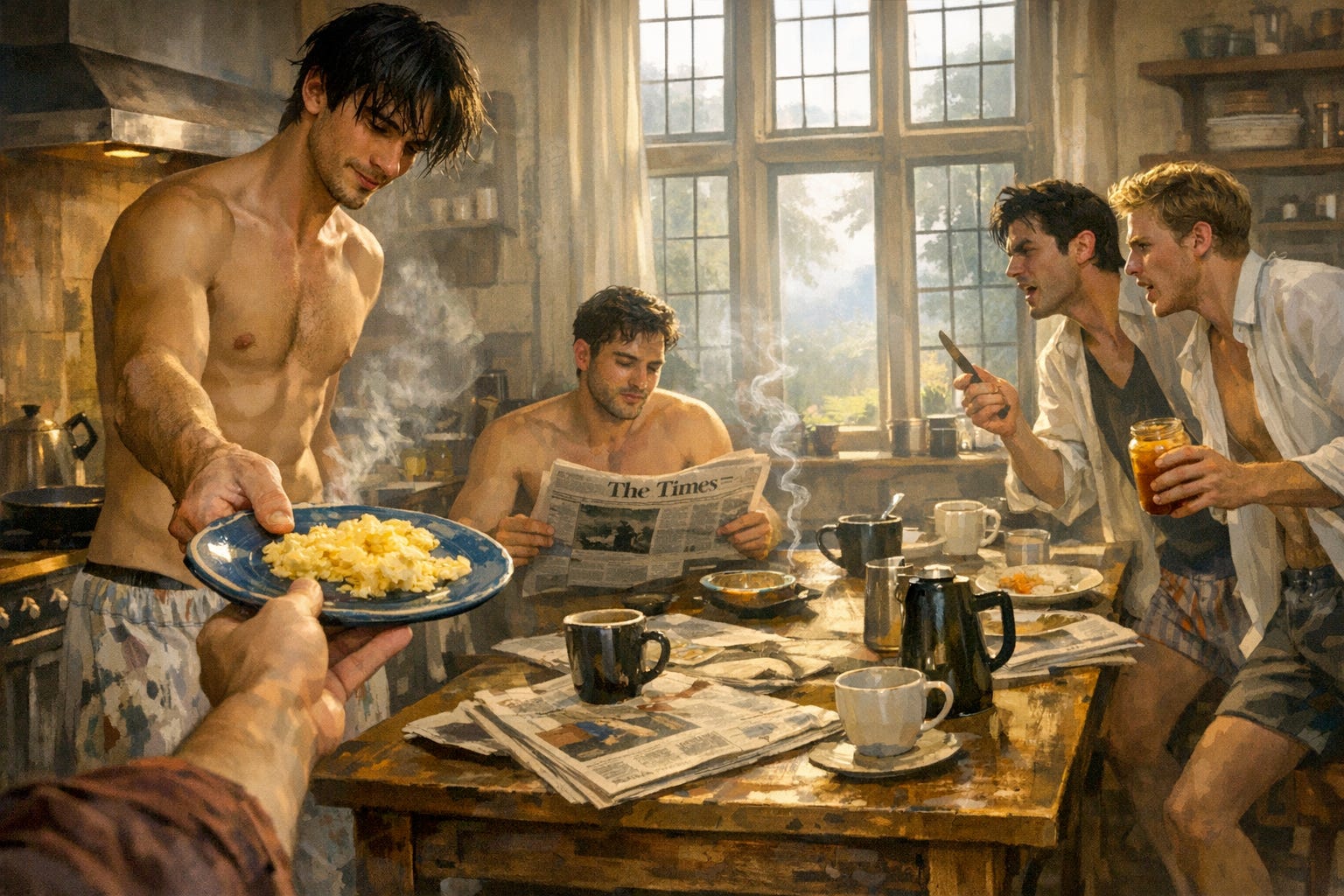
Downstairs, I found the kitchen full of men in various states of dress. Julian stood at the stove making eggs, wearing only a pair of paint-stained pajama bottoms slung low enough to show the sharp cut of his hipbones. Sebastian sat at the table reading The Times, shirtless. Two others I hadn’t met yet were arguing about Britten’s War Requiem, both in underwear and unbuttoned shirts.
“James, yes?” Julian said, glancing over his shoulder. “Tea’s in the pot. Help yourself to anything.”
I poured tea and perched on a stool, trying to seem relaxed. The conversation flowed around me—something about an exhibition at the Tate, someone’s disastrous tutorial on Seneca, weekend plans involving London and a party in Belgravia.
“The problem with Britten,” I found myself saying, “is that everyone focuses on the War Requiem and ignores the church parables. Curlew River is extraordinary—all that plainchant influence, the way he uses silence.”
The room went quiet. Sebastian looked up from his newspaper.
“You know Britten?” one of the others asked—a slender boy with wire-rimmed glasses.
“I sang Madwoman in a production at Columbia. Small role, but it got me interested in the whole trilogy.”
“Christ,” Julian said. “Does Theo know you’re musical?”
“Why does everyone keep asking about Theo?”
“Because he’s always looking for people to sing with,” Sebastian said. “He’s working on Schubert duets. And if you’re a lyric tenor...” He trailed off meaningfully.
After breakfast I found Marcus in the library, and the sight of it stopped me at the threshold. It was a two-story room, the tower forming one curved wall lined floor to ceiling with books. A spiral staircase led to a gallery level. Leather chairs clustered around a massive fireplace. The morning light fell through tall windows onto Persian rugs worn soft with age.
Marcus looked up from a folio spread across a reading table. “Impressive, isn’t it? Lord Pemberton’s personal collection, mostly. First editions, manuscripts, things you can’t see anywhere else. The college curators have catalogued it all, but we’re allowed to use anything as long as we’re careful.”
I moved along the shelves in a kind of trance. Browning, Wilde, Byron, Housman. A section of erotica tucked between philosophy and poetry—Teleny, The Sins of the Cities of the Plain, beautifully bound editions of Classical texts with certain passages marked by silk ribbons.
“Pemberton was very specific about the collection,” Marcus said, coming to stand beside me. “He wanted it to be educational in the broadest sense. Mind and body. Aesthetic and erotic.” He pulled down a slim volume. “Look at this. His own annotated copy of the Greek Anthology. All the pederastic epigrams translated, with his own rather detailed commentary.”
I paged through it carefully. The marginalia was indeed detailed—and explicit. Pemberton had been nothing if not thorough in his appreciation of ancient Greek sexuality.
“He must have been remarkable,” I said.
“By all accounts, yes. Scandalous, obviously. He was essentially exiled here after some affair in London. But he used his money brilliantly—endowed the house, stocked the library, established the traditions.” Marcus returned the book to its shelf. “Most of the students here now are connected to families who knew him. Or knew of him.”
“Connected how?”
“Old families. The kind with peerages and country estates.” He said it without self-consciousness. “My great-great-uncle was one of Pemberton’s original residents. Sebastian’s grandfather, same. Theo’s family has been sending sons here for three generations. It’s a bit incestuous, actually. Half the house went to school together—Eton, Harrow, Winchester.”
I felt suddenly very American, very middle-class. “And they just... let anyone in now?”
“They let in people who belong,” Marcus said carefully. “It’s not about money anymore. It’s about temperament. Aesthetic sensibility. The admissions committee can smell someone who won’t fit.” He looked at me directly. “You’re here because someone read your application and recognized something. Trust that.”
We spent the morning in the library. Marcus showed me the catalog system, pointed out treasures, explained the house’s academic resources. Around eleven, others began to drift in—Sebastian with his Ovid, David to practice on the piano that occupied one corner, Julian to sketch by the windows.
The door to the library stayed open. People came and went. And I began to notice something else about the house’s culture: the absence of privacy wasn’t accidental. It was deliberate.
Someone would be reading, and another person would enter, sit nearby, strike up a conversation. Bodies touched casually—a hand on a shoulder, someone leaning over to look at a book, knees bumping under tables. When David played, others would gather to listen, sprawling on furniture, and the listening itself felt intimate, like being allowed into something private.
Around noon, Theo appeared. He wore running clothes—shorts and a fitted shirt dark with sweat—and his hair was damp. He went directly to the piano, stretched briefly, then began a series of vocal exercises. Scales, arpeggios, his voice moving through registers with casual power.
Everyone stopped what they were doing to listen. Not obviously—people kept reading, talking—but the quality of attention changed. Theo’s voice filled the room like a physical presence, and I understood what Julian had meant. It was quite something.
Without thinking, I began to hum along quietly—matching his pitches, following the pattern. My voice was softer than his, lighter, but it blended well. I didn’t realize I was doing it until the room had gone completely silent.
Theo had stopped singing. He was staring at me.
“Do that again,” he said.
“I’m sorry, I didn’t mean to—”
“Don’t apologize. Just sing.” He played a chord on the piano. “Match this.”
I sang the note. He played another, higher. I followed. We went through a series of intervals, my voice opening up as it warmed. I could feel everyone watching, but Theo’s gaze was so focused, so intent, that everything else fell away.
“Range?” he asked.
“C to high C. Sometimes higher if I’m warmed up properly.”
“Passaggio?”
“Around E-flat, F.”
He stood from the piano bench, came closer. “Sing something. Anything. A song you know well.”
My mind went blank. Then, almost involuntarily, I began the opening of Dowland’s Flow My Tears—the piece I’d sung for my Columbia audition, the one my voice teacher had said showed my tone at its best. The library’s acoustics were extraordinary; the sound seemed to hang in the air like something visible.
I made it through the first verse before Theo held up a hand.
“Where did you train?” His voice was different now—still controlled, but with an edge of excitement.
“Just high school choir and two years of lessons at Columbia. Nothing formal.”
“Nothing formal,” he repeated, as if I’d said something absurd. “You have one of the most beautiful natural instruments I’ve heard in years and you’ve had two years of lessons?”
“I was planning to study English, not music—”
“Marcus, why didn’t you tell me?” Theo turned on him.
“I only found out this morning. He was singing in the shower.”
Theo looked back at me, and there was something in his expression I couldn’t quite read—hunger, maybe, or a kind of possessive appreciation. “We’re singing together. The Schumann Dichterliebe—I’ve been looking for someone to work through it with. And there’s a Purcell duet that would suit us perfectly.” He was already moving toward a shelf of scores. “Do you read music?”
“Yes, but I’ve never done art song. Just choral work and some musical theater—”
“Even better. You won’t have bad habits to unlearn.” He pulled down several scores, paging through them rapidly. “We’ll start tomorrow. One hour before breakfast. The tower studio has better acoustics than down here.”
“Theo,” Marcus said mildly, “you might ask if he’s interested.”
“Of course he’s interested. Anyone with a voice like that wants to use it properly.” Those blue eyes found mine again. “Unless I’m wrong?”
I should have been annoyed by his presumption. Instead, I felt a thrill run through me. “No. You’re not wrong.”
“Good.” He smiled, and it transformed his face. “This is excellent. Really excellent. We’ll need to work on your breath support—I heard you running out of air in the second phrase. And your diction could be clearer. But the tone, the natural placement...” He shook his head. “It’s remarkable.”
He spent the next twenty minutes at the piano, running me through exercises, adjusting my posture with hands on my ribcage, my shoulders. His touch was professional, clinical, but I was acutely aware of it—of his fingers pressing just below my sternum, of how close he stood, of the smell of sweat and cologne.
“There,” he said finally. “Feel that? You’re lifting from the diaphragm now, not the throat. Remember that sensation.”
When he finally released me and went upstairs to shower, I felt wrung out, exhilarated.
Marcus was watching me with amusement. “Well. That was something.”
“Does he do that to everyone?”
“Only the ones he finds interesting.” He returned to his Greek text. “Consider yourself noticed.”
That afternoon I explored the house more thoroughly. The ground floor had the library, the common room, the kitchen and dining room. The second floor was bedrooms—twelve of them, most with doors standing open. I passed one where two students lay on a bed together, one reading aloud while the other listened with eyes closed, his hand resting on the reader’s thigh. They glanced up as I passed but didn’t seem concerned.
Another room: someone changing clothes, stripped to his underwear, unselfconscious as Marcus had been. He was uncircumcised—they all were, I was realizing. It was such a small thing, but it felt emblematic of a larger difference. These men were foreign in ways that went beyond accent.
The third floor was mostly Theo’s—the tower room plus a music studio and what appeared to be a small archive. I didn’t venture up there, though I wanted to.
Back on the second floor, I heard water running and followed the sound to a bathroom at the end of the hall. The door was ajar. Through it I could see Sebastian in the shower—one of those old claw-foot tubs with a curtain rod, except the curtain was pulled aside. He was washing his hair, body on full display, and he was... beautiful. Classically proportioned, olive-skinned, everything in perfect balance.
He opened his eyes and saw me standing there. I should have fled, but I froze.
“James, yes?” He didn’t cover himself, didn’t seem remotely embarrassed. “Bit different from American dorms, I imagine. We’re not particularly modest here. Comes from boarding school—you get used to communal showers quite young.”
“Sorry, I didn’t mean to—”
“Don’t apologize. It’s fine.” He turned off the water and stepped out, reaching for a towel. “Fair warning—most of the bathrooms don’t have locks. House rule. Something about trust and openness. You’ll adapt.”
I went back to my room and found Marcus at his desk, still in just his underwear—a pair of tight gray briefs that left very little to imagination. He’d kicked off his jeans at some point and apparently seen no reason to put them back on.
“You look overwhelmed,” he observed.
“Is everyone here just... naked all the time?”
He laughed. “Not all the time. But we’re not precious about it. Most of us grew up in dormitories where privacy was a luxury. You showered with fifteen other boys, changed in front of each other, slept six to a room at house parties.” He swiveled in his chair to face me. “And yes, there’s also an element of... aesthetic appreciation. Of classical ideals. The male form as art object. It’s all very Pemberton.”
I sat on my bed, trying to process. “And everyone’s just... comfortable with that?”
“Everyone who stays is.” He regarded me seriously. “Look, if this isn’t for you, you can request a room change. No one would judge you. But I think you should give it a few days. You might find it’s actually rather freeing, not having to maintain all those careful boundaries.”
“Is everyone here...”
“Queer? No. Maybe half. The others are what you might call aesthetically flexible. Appreciative of beauty regardless of gender. Or they’re straight but secure enough not to be threatened by it all.” He paused. “Why do you ask?”
“Just trying to understand the dynamics.”
“The dynamics are simple: we’re all attracted to beauty, to intelligence, to talent. Sometimes that manifests sexually. Sometimes not. The house doesn’t particularly care which.” He turned back to his work. “You’ll see on Friday. The symposium makes it all rather explicit.”
I spent the rest of the afternoon reading, hyperaware of Marcus’s near-nudity across the small space, of the sounds of the house around us. Someone playing guitar. Laughter from downstairs. A snippet of conversation in French.
Around five, Theo’s voice drifted down from the tower—proper singing now, not exercises. Something in German, achingly sad. The whole house seemed to hold its breath while he sang.
“Winterreise,” Marcus murmured. “He’s been working on it all term. Schubert’s cycle about lost love and winter journeys and death.” He looked up. “Theo lost someone last year. Another student. Fell from a roof at a party in London. Since then he’s been... intense about the darker repertoire.”
I listened until the song ended. The silence afterward felt heavy.
At six we dressed for dinner in hall—jacket and tie, as Theo had warned. Marcus knotted his tie with practiced ease, transformed suddenly into someone who could have walked out of a 1930s photograph. When the rest of the house gathered in the entrance hall, they all looked like that: aristocratic, elegant, slightly louche. Old money worn lightly.
I felt like an impostor in my off-the-rack blazer.
But Theo appeared at my elbow as we walked across campus. “You look fine,” he said quietly. “Stop fidgeting with your collar.”
“That obvious?”
“Extremely.” But his tone was kind. “Half of them are broke anyway. All those country estates are crumbling. They just know how to wear the costume.” He adjusted my tie with quick, efficient fingers. “There. Now you look like you belong.”
His touch lingered a moment longer than necessary.
At dinner I sat between Marcus and Julian, surrounded by conversation about people and places I didn’t know—weekends at Chatsworth, someone’s sister’s wedding at Blenheim, a disastrous shoot in Scotland. The class markers were subtle but pervasive: the way they held their forks, the casual name-dropping, the assumption of access.
But when we returned to Apollo House afterward, everything softened again. Jackets came off, ties were loosened. Someone opened wine. David played Debussy while others read or talked or simply existed in comfortable proximity.
Theo came and sat beside me on the sofa, close enough that our thighs touched. He’d changed into soft trousers and a linen shirt, and he smelled clean, expensive.
“I’ve been thinking about repertoire,” he said. “There’s a Monteverdi duet—Zefiro torna—that would be perfect for us. Have you sung any early music?”
“Some madrigals in choir.”
“Good. The ornamentation will come naturally to you, I think. You have good instincts.” He shifted closer. “I haven’t been this excited about collaboration in months. Most tenors I know are either too heavy for what I want to do or too precious about their technique.”
“And I’m neither?”
“You’re raw. Unpolished. But the instrument itself is...” He paused, seeming to search for the word. “Pure. That’s rare.”
The way he looked at me made my breath catch. It wasn’t quite sexual—or not only sexual. It was the look of someone who’d found something valuable and wanted to possess it.
“Six-thirty tomorrow,” he said. “Don’t be late. And don’t eat too much at breakfast—it affects the support.”
Later, in our room, Marcus stripped unselfconsciously and climbed into bed naked. I changed in the bathroom again, still unable to match his ease.
“He’s going to consume you, you know,” Marcus said in the darkness. “Theo. When he finds someone talented, he becomes obsessive about developing them. It’s flattering at first.”
“And then?”
“And then you realize you’ve become part of his collection. Another beautiful thing he’s acquired and shaped.” A pause. “I’m not saying don’t do it. Just... be aware.”
But I lay awake for a long time, my body humming with an awareness I couldn’t name. Awareness of Marcus breathing across the room. Of the house settling around us. Of tomorrow morning, when I’d climb the tower stairs to Theo’s studio and let him put his hands on my ribcage again, adjusting my breath, shaping my sound.
I thought about his voice singing of winter and loss. About the way he’d looked at me when I sang Dowland. About all these beautiful, damaged, aristocratic boys and their casual intimacy with each other and with their own bodies.
And I thought: I want this. Whatever it is, whatever it costs, I want to be part of it.
Outside, an owl called. The old house breathed.
I touched myself quietly in the dark, thinking of Theo’s hands on my ribs, his breath warm against my ear as he demonstrated phrasing, and fell asleep still wanting.
Great stuff! I know almost nothing about classical music. But you write about what you know, do it well and make it accessible. I like the premise - an impossible college where joyful same sex attraction is norm. Yet, there would have to be some serious structure, enforced in some acceptable way, to avoid drama, cruelty and exclusion. I'm interested in how you handle this...
This is going to be a great read. I love the way you have eased James into the house and had Marcus give it some history and background. But I am sure that all of the history has been revealed yet. And James picked up on the almost all male vibe upon arrival before heading up to the Apollo House. And he seems to be adjusting as well as an American can with the "freeness" of the house. Clothes and closeness of bodies that are missing in the American culture. Sadly.
Looking forward to Theo and James's practice session before the Friday night activities.