
A Note in the Dark (Part 5)

Chapter 9: The Rehearsal Spiral
By late November, the opera had begun to devour them all.
Days bled into nights in the damp, echoing rehearsal hall. The walls smelled faintly of sweat, dust, and varnish; a single overhead bulb flickered like an exhausted star. The piano was always slightly out of tune. And yet Adrian, somehow, wanted more — more feeling, more risk, more exposure.
It was on such a night that Luca arrived.
He was older than the rest, maybe mid-thirties, an Italian baritone with a reputation that came before him — the kind of man who didn’t just enter a room but rearranged its air. He had a voice like smoke, deep and grainy, and the kind of languid arrogance that made you want to both slap him and kiss him.
Adrian introduced him with a faint smile. “This is Luca Ferri. He’ll be joining us as the Commendatore.”
The word hung in the air, funereal and faintly comic. Luca gave a short bow. His eyes — gray, unreadable — lingered first on Adrian, then on Matteo, and finally on Rafi.
That look was slow, deliberate, and devastating.
During break, Luca was already laughing with Adrian in the corner, an intimacy that didn’t need translation. Matteo watched them from across the room, jaw tight. Rafi, meanwhile, was trying to steady himself — to stay focused on the music — but Matteo’s hand kept finding his thigh under the piano bench.
Hassan saw it once. Just the brief brush of skin against skin. He didn’t say anything. But later, walking back to the dorms, he couldn’t stop thinking about it — the way Rafi’s eyes had followed Matteo, the way something trembled in his voice when he spoke about rehearsal.
He’d always known Rafi was intense, but this was different. Secretive. Hollowed out.
The next rehearsal blurred the line between art and something else entirely.
They were staging the duet between Giovanni and Ottavio — Adrian’s “reimagined” version, full of sexual tension. “It’s not about rivalry,” Adrian said, pacing in front of them. “It’s about hunger. Giovanni wants Ottavio’s devotion — and Ottavio wants to be devoured.”
The room was hot, airless. Sweat gleamed on their necks.
Rafi’s shirt clung to him; Matteo’s eyes were dark, merciless. Adrian pushed them closer, voice low, coaxing.
“Touch him. Don’t pretend. Feel it.”
Rafi did. His fingers brushed Matteo’s chest, then lingered. The music surged. Something in the air cracked — a pulse, an ache, a warning.
Adrian’s lips curved in satisfaction. “Good. Now again.”
When the rehearsal finally ended, the room was silent except for their breathing. Matteo looked at Rafi for a long moment before walking out without a word.
Adrian watched him go, expression dark.
That night, Hassan went looking for Rafi. He found himself outside the studio, hearing voices — Matteo and Luca, sharp and low.
“You think Adrian won’t find out?” Matteo was saying.
Luca’s laugh was soft, derisive. “He already knows. He always knows.”
A pause. Then Matteo again, colder: “Don’t push me.”
When Hassan looked through the half-open door, Matteo’s hand was balled into a fist. Luca smiled and turned away, brushing invisible dust off his sleeve.
Hassan stepped back before they could see him. His heart was hammering.
Later that night, in his room, he opened his laptop and typed Matteo Ferrante.
The search results were unsettling — tabloid photos, gossip columns in Italian. Older men. Scandals. A whispered rumor about a director in Milan, another in Rome.
He closed the browser. The silence that followed was unbearable.
Rehearsals grew stranger after that. Adrian demanded a new ending — a real confrontation between Giovanni and the Commendatore, “not metaphorical death, but something raw, elemental.” Luca laughed and said, “Art needs a little danger. A little death.”
Matteo didn’t laugh.
Neither did Rafi.
That night, rain fell in long silver threads across the campus. Hassan couldn’t sleep. Somewhere in the distance, he heard sirens — faint, then closer, urgent.
By morning, the rumor was everywhere.
Luca Ferri had been found in the canal.
Chapter 10: The Body in the Canal
The morning after Luca’s death, the campus was unnervingly bright.
Police cars were parked along the narrow road behind the conservatory. Their lights flashed lazily in the pale winter sun, red and blue bleeding into the puddles. Word spread before breakfast: a body had been found in the canal just beyond the sculpture garden. It was Luca Ferri.
The news seemed impossible — too theatrical to be real, too perfectly staged.
Rafi stood at his window, staring out at the flashing lights, his breath fogging the glass. For a long time, he didn’t move. Hassan knocked twice before coming in.
“Raf,” he said quietly, “you should eat something.”
Rafi turned, his face drawn. “Did you hear—?”
Hassan nodded. “Everyone’s talking about it. They say he drowned.”
“Luca didn’t drown,” Rafi said, voice flat. “He was too proud to die like that.”
The words sounded strange once he said them aloud.
That afternoon, rehearsal was cancelled. Students drifted through the halls in small, whispering groups. Posters for Don Giovanni had been taken down.
Adrian called a meeting in the black-box theatre. His eyes were red, though it was unclear whether from grief or lack of sleep.
“This is a tragedy,” he said softly, “and I expect everyone to respect Luca’s memory. But we will continue the production. Art doesn’t stop for death.”
Rafi felt Matteo tense beside him. He looked at Adrian — that calm, predatory composure — and felt a cold ripple of unease.
Adrian’s gaze swept the room and lingered on him just a second too long.
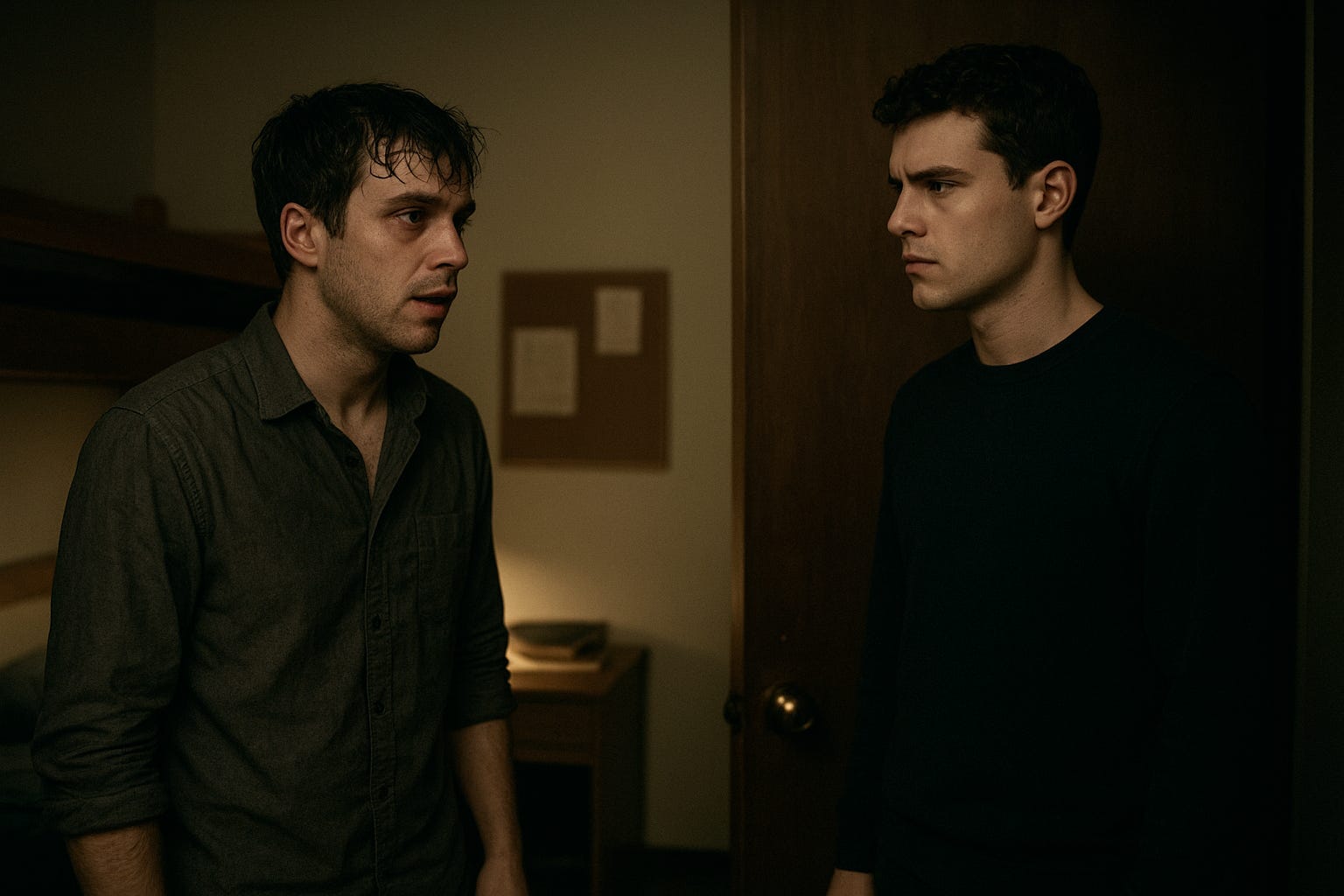
Later that night, Matteo showed up at Rafi’s dorm. His eyes were bloodshot; his shirt smelled faintly of rain and whiskey.
“You think I did it,” he said.
Rafi didn’t answer. The silence between them was its own confession.
Matteo laughed once — a low, dangerous sound. “He was blackmailing me. But I didn’t touch him. You have to believe that.”
“Why should I?” Rafi whispered. “You lie as easily as you breathe.”
Matteo’s smile faltered. “You don’t understand Adrian. He—”
“Stop.” Rafi stepped back. “I don’t want to hear it.”
Matteo’s eyes flickered with something like panic. Then he was gone, the door closing quietly behind him.
In the days that followed, Rafi avoided him. He went through classes in a fog, the music hollow in his ears. At night, he couldn’t sleep. He kept seeing Luca’s face — or the shadow of it — rising from dark water.
That’s when Hassan began to notice.
“You haven’t been yourself,” he said one night, sitting on the floor beside Rafi’s bed. “Is it because of the show?”
Rafi shook his head.
“Raf,” Hassan continued, softer now, “if something’s wrong, you can tell me. You know that, right?”
There was a pause — a long one. Then Rafi said, barely audible, “I think I was sleeping with someone who might have killed him.”
Hassan froze. The words seemed to suck all the air from the room.
He wanted to say something — to ask who, to deny it, to comfort him — but he couldn’t. His chest hurt.
Rafi looked up, eyes glistening in the dim light. “Promise me you won’t tell anyone.”
Hassan nodded. “I promise.”
But he didn’t sleep that night either.
By the weekend, he’d begun digging. Quietly. Carefully.
Luca’s death hadn’t been officially ruled a murder yet — but there were inconsistencies: bruises on the wrists, a phone missing, a fight reported near the theatre the night before.
And Adrian — the way he had watched them during rehearsal, the strange intimacy with Luca, the private texts Rafi had mentioned once, jokingly — “Adrian flirts with everyone.”
Hassan wasn’t so sure it was just flirting.
He printed out an article about Luca’s earlier career in Europe. Near the end, a line caught his eye:
In 2018, Ferri abruptly left the Venice Opera House following a mysterious onstage altercation with the production’s young director, Adrian Lemaire.
The photo showed Adrian, younger, standing beside Luca. They were smiling, but their bodies told another story — distance disguised as composure.
Hassan felt a chill run down his spine.
That night, Rafi was alone in the practice room when Adrian appeared in the doorway.
“You’ve been avoiding me,” Adrian said gently.
Rafi didn’t look up. “I’ve been busy.”
Adrian crossed the room, close enough that Rafi could smell his cologne — sharp, metallic, unsettling.
“Matteo’s unraveling,” Adrian murmured. “And I can’t have my Giovanni unravel. I need you to stay focused.”
Rafi finally looked up. “You don’t care that a man’s dead?”
Adrian smiled faintly. “On the contrary. I care very much. But sometimes art demands sacrifice.”
The piano between them felt suddenly fragile — a line that could be crossed too easily.
Rafi whispered, “You knew Luca, didn’t you?”
Adrian’s smile deepened. “We all know each other, eventually.”
Then he turned and walked out, leaving the door ajar and the scent of his cologne hanging in the air.